Published preclinical research has investigated KPV’s role in NF-κB pathway suppression, mast cell stabilization, and the modulation of pro-inflammatory cytokines including TNF-α and IL-1β. The peptide has been studied in models of inflammatory bowel disease, allergic responses, and skin inflammation. Its small molecular size and stability have made it an interesting candidate for both topical and systemic research formulations.
Common research applications include: in vitro studies on cytokine signaling and mast cell degranulation, rodent models of colitis and inflammatory bowel disease, dermatological inflammation research, oral and mucosal absorption studies, and combinatorial work pairing KPV with regenerative peptides to evaluate inflammation-and-repair synergy. KPV is also a key component of our “KLOW” four-peptide research blend.
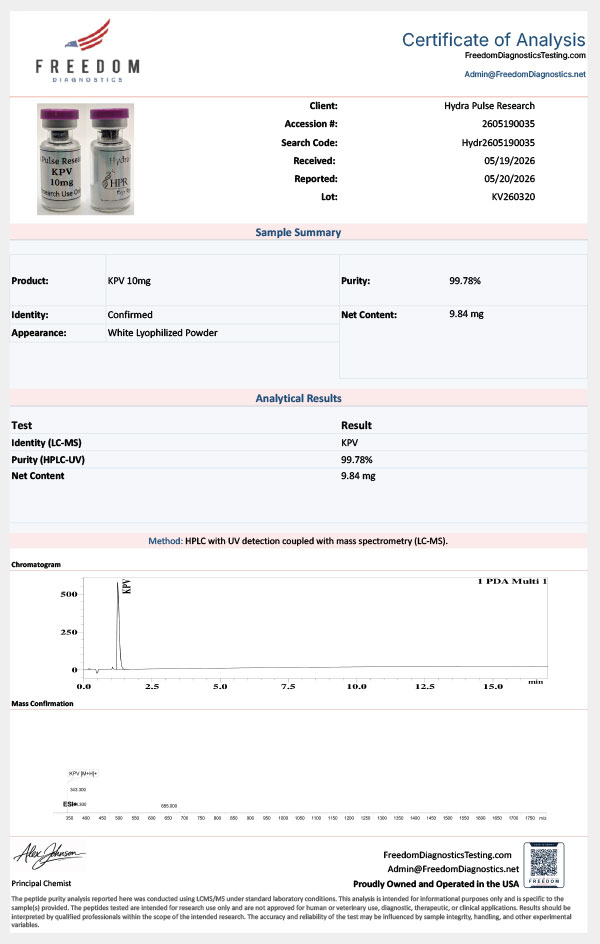
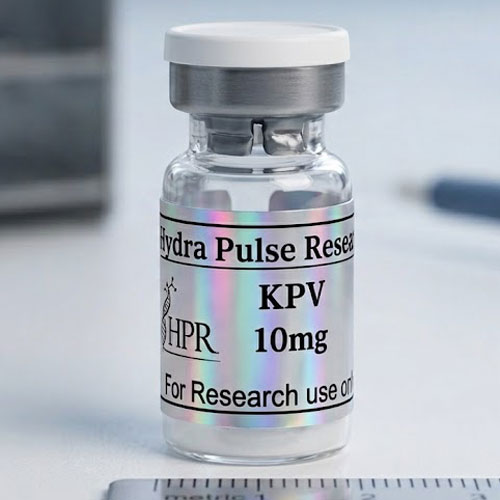
Hydra Pulse Research KPV is supplied as a sterile lyophilized powder in tamper-evident vials, accompanied by a Certificate of Analysis verifying identity, mass, and purity. Each lot is independently tested before release, and we maintain full documentation for batch traceability.
Reconstitution: KPV is water soluble. Use bacteriostatic water for injection-format research or sterile water for in vitro work. Store the lyophilized vial frozen at -4°F to -20°F. After reconstitution, refrigerate at 36°F–46°F and use within 28 days for optimal experimental consistency. Avoid repeated freeze-thaw cycles.
KPV is well represented in the literature on alpha-MSH-derived peptides — investigators studying melanocortin signaling often use KPV as a tool compound to isolate the C-terminal anti-inflammatory activity from the broader hormone. This makes it a useful research probe for laboratories studying inflammation pathways without the receptor activity of full-length α-MSH.